Introduction
Stainless steel drying trays are essential auxiliary equipment widely used in industrial drying, food processing, pharmaceutical production, chemical dehydration, and agricultural product drying industries. Compared with plastic, aluminum, and iron drying trays, stainless steel drying trays stand out for their high temperature resistance, corrosion resistance, non-toxicity, easy cleaning, and long service life. They can maintain stable structural performance and surface flatness in long-term high-temperature drying and humid working environments, effectively meeting the standardized drying and storage needs of various materials. This article comprehensively introduces the common material grades, conventional size specifications, and personalized custom options of stainless steel drying trays, providing a reliable reference for enterprise selection and customized procurement.
Common Stainless Steel Grades for Drying Trays
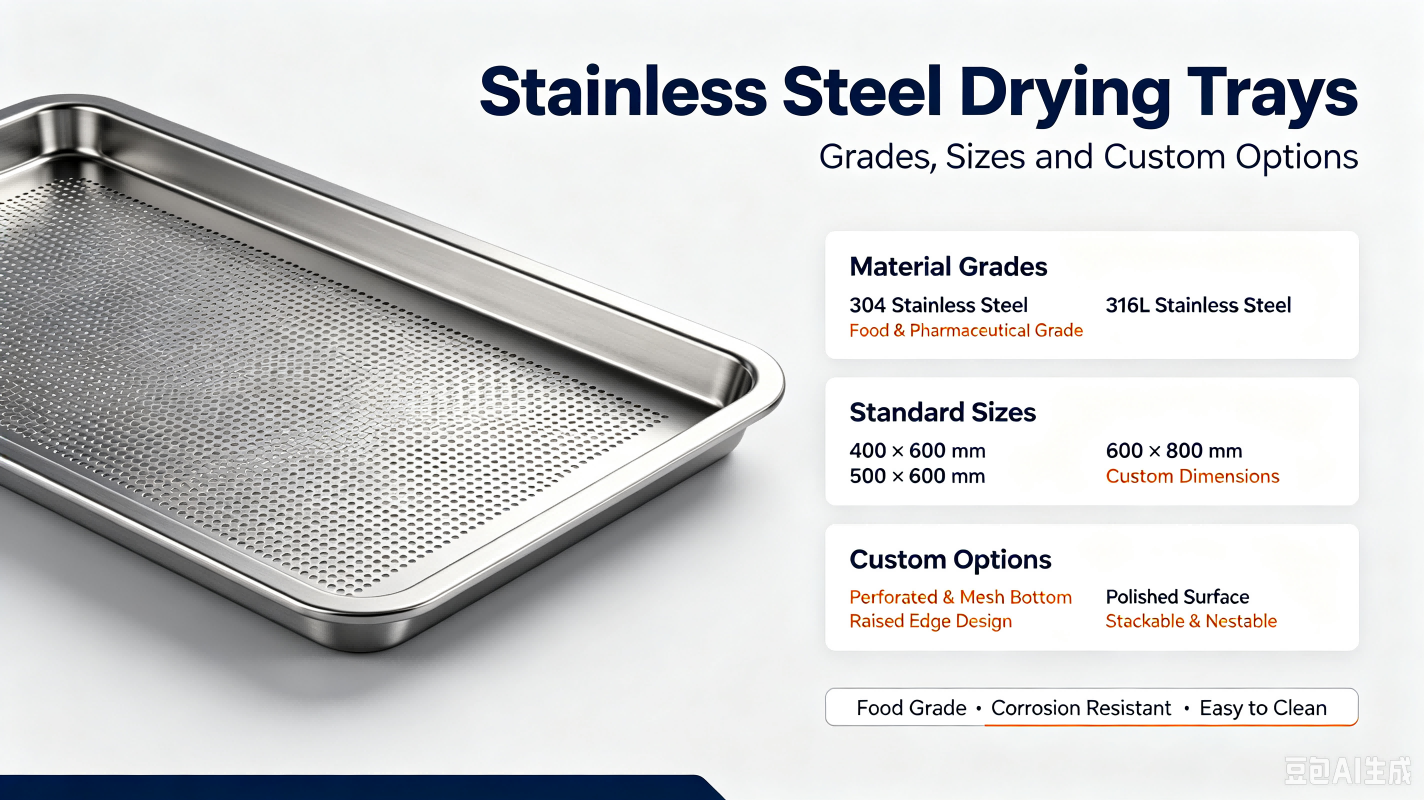
The material grade is the core factor determining the service performance and application scope of drying trays. Different stainless steel grades differ greatly in corrosion resistance, high temperature resistance, oxidation resistance, and cost, which are suitable for different production scenarios. The mainstream grades in the market are 201, 304, and 316L, covering civilian, industrial and high-standard sterile production fields respectively.
201 Stainless Steel
201 stainless steel is a cost-effective conventional grade with good hardness and tensile strength. It has certain rust resistance in dry indoor environments and is suitable for low-corrosion and low-standard drying scenarios. However, its corrosion resistance is weak in humid, acidic and alkaline environments, and it is prone to oxidation and rust after long-term use. It is mostly used for drying ordinary agricultural products, hardware accessories, and non-corrosive industrial materials, and is the preferred material for civilian and low-cost batch production.
304 Stainless Steel
304 stainless steel is a food-grade and general industrial grade, which is the most widely used material for drying trays. It has excellent anti-rust, anti-oxidation and mild corrosion resistance, can adapt to most high-temperature drying environments, and is non-toxic and harmless, meeting food and pharmaceutical safety standards. The material has stable performance, no deformation at conventional drying temperatures, and is easy to clean and disinfect. It is suitable for food drying (fruits, vegetables, nuts), daily chemical products, general pharmaceutical raw materials, and ordinary chemical material drying, occupying the mainstream market share of medium and high-standard drying trays.
316L Stainless Steel
316L stainless steel is a high-end corrosion-resistant grade, added with molybdenum element on the basis of 304, which greatly enhances its resistance to acid, alkali, salt water and chemical corrosion. It has ultra-high stability in high-temperature, humid and strong corrosive environments, and has excellent sterile and anti-oxidation performance. This grade is mainly used for high-standard production scenarios such as pharmaceutical sterile drying, chemical corrosive material dehydration, seafood salt water drying, and high-precision electronic component drying. It is the best choice for industrial drying trays with strict environmental and safety requirements.
Standard Size Specifications of Drying Trays
Stainless steel drying trays have mature standard size systems, which are compatible with most drying ovens, drying rooms, tunnel dryers and other equipment on the market. The sizes are mainly divided into conventional square and rectangular specifications, with unified standards for thickness, mesh density and border height, which can meet the assembly and stacking requirements of standardized drying equipment.
Conventional External Dimensions
The mainstream standard sizes include 400×600mm, 500×700mm, 600×800mm, 800×1000mm, etc. Among them, 600×800mm is the most universal size, compatible with most household and industrial small and medium-sized drying equipment, and is widely used in food and agricultural product processing. Small-sized trays of 400×600mm are suitable for laboratory small-batch drying and precision material processing; large-sized trays of 800×1000mm and above are used for large-scale industrial drying production to improve single-batch processing capacity.
Plate Thickness and Border Specifications
The common plate thickness of drying trays is 0.8mm–2.0mm. Thin plates of 0.8mm–1.2mm are light in weight, easy to carry and stack, suitable for light-load material drying; thick plates of 1.5mm–2.0mm have strong compression resistance and are not easy to deform, suitable for heavy-load industrial material drying and long-term high-frequency use. The border height is conventionally 20mm–50mm, which can prevent materials from sliding off during drying and handling, and support multi-layer stacking without pressure deformation.
Mesh and Solid Plate Types
According to the plate surface structure, it is divided into mesh trays and solid trays. Mesh trays have uniform air permeability, fast drying speed, and no dead angle of hot air circulation, which is suitable for granular, flaky and block materials such as fruits, vegetables and grains; solid trays have good sealing performance, no material leakage, and are easy to clean, suitable for powder, paste and fine particle materials to avoid waste and pollution.
Custom Options for Stainless Steel Drying Trays
In view of the differentiated equipment sizes, material characteristics and production process requirements of different enterprises, we provide all-round personalized custom services for stainless steel drying trays, covering size optimization, structural design, process treatment and functional customization, to realize one-stop matching with customer production equipment.
Size Customization
Support non-standard length, width and height customization, including special-sized trays matching non-standard drying ovens, ultra-long and ultra-wide trays for large drying production lines, and mini trays for laboratory precision experiments. We can also adjust the border height and edge bending angle according to customer needs to adapt to special stacking and handling methods.
Structural Customization
According to material attributes, customize different mesh apertures (1mm–20mm adjustable), mesh spacing and solid plate flanging structure. For easy-scattering fine materials, customize dense mesh and anti-leakage flanging; for bulky materials, customize large-aperture high-air-permeability mesh. In addition, we can add reinforcing ribs at the bottom of the tray to enhance compression resistance, and design handles, card slots and positioning grooves to facilitate assembly and handling.
Surface Process Customization
Provide diversified surface treatment processes: polished finish (mirror polishing, matte polishing) to meet food and pharmaceutical sterile standards; sandblasting treatment to increase surface friction and prevent materials from sliding; passivation treatment to enhance corrosion resistance and extend service life. All processes can effectively avoid rust, oxidation and residue adhesion, ensuring clean and hygienic use.
Functional Customization
Support customized anti-high temperature, anti-corrosion special treatment, and add numbered marks, anti-skid devices and limit structures according to production management needs. For special industries such as chemical industry and environmental protection, we can customize trays with acid and alkali resistance and high temperature resistance to adapt to harsh production environments.
Application Scenarios and Selection Suggestions
Stainless steel drying trays are widely applicable in multiple industries. 201 stainless steel trays are recommended for low-budget, dry and non-corrosive conventional drying scenarios; 304 food-grade trays are the first choice for food processing, daily chemicals and general pharmaceutical industries, with high cost performance and wide applicability; 316L high-corrosion-resistant trays are suitable for high-standard sterile production and corrosive material drying scenarios.
In terms of size and structure, users can select standard specifications for conventional equipment to save procurement cost and cycle; for non-standard equipment and special process requirements, personalized customization is adopted to ensure the matching degree between trays and production lines, so as to improve drying efficiency and product yield.
Conclusion
As a key auxiliary component of drying equipment, the grade, size and customization of stainless steel drying trays directly affect production efficiency and product quality. Reasonable selection of material grades and standard sizes, and targeted personalized customization according to actual production needs, can maximize the service performance of drying trays, reduce equipment matching costs, and bring stable and efficient production guarantees for enterprises. With reliable material quality, complete specifications and flexible customization services, our stainless steel drying trays can fully meet the diversified production needs of various industries.