Pharmaceutical Granulation Equipment: A Complete Buying Guide
1. Introduction
Granulation is a core unit operation in pharmaceutical manufacturing, designed to convert fine drug powders into uniform, free-flowing granules. This critical process solves common production problems including powder agglomeration, poor fluidity, uneven ingredient mixing, and low tablet compression efficiency. High-quality granulation directly guarantees consistent tablet weight, stable drug dissolution rate, and reliable batch-to-batch product quality.
Pharmaceutical granulation equipment varies greatly in working principle, production capacity, material adaptability, and GMP compliance level. Choosing the wrong machine will lead to unstable granule quality, frequent production failures, excessive material waste, and even failure to pass factory audits. This complete buying guide systematically classifies mainstream pharmaceutical granulation machines, analyzes key performance parameters, summarizes professional selection criteria, compliance requirements, and cost-control tips, helping pharmaceutical manufacturers make accurate, cost-effective, and compliant purchasing decisions.
2. Main Types of Pharmaceutical Granulation Equipment & Working Principles
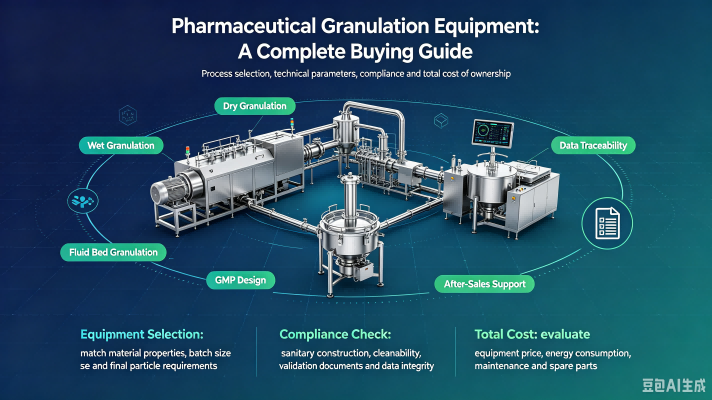
According to different production processes and working mechanisms, pharmaceutical granulation equipment is mainly divided into three mainstream types: wet granulation machines, dry granulation machines, and fluid bed granulation machines. Each type has unique process characteristics and targeted applicable scenarios.
2.1 Wet Granulation Machine (High-Shear Mixer Granulator)
Wet granulation is the most widely used traditional granulation technology in the pharmaceutical industry. The equipment integrates mixing and granulation functions. It adds quantitative adhesive liquid into uniformly mixed powder materials, and relies on high-speed rotating stirring paddles and cutting blades to force powder particles to bond, aggregate, and form uniform wet granules.
Core advantages: Uniform granule particle size, high granule roundness, strong structural hardness, good powder bonding effect, and stable finished tablet quality. It can effectively improve the fluidity and compressibility of inferior fine powders.
Applicable scenarios: Conventional tablet, capsule, and granule drug production; suitable for most common pharmaceutical raw materials with no strict heat-sensitive restrictions.
2.2 Dry Granulation Machine
Dry granulation is a physical extrusion granulation technology without adding any adhesive liquid. The equipment uses two opposite rotating pressure rollers to squeeze fine powder into dense thin flakes, and then crushes and sieves the flakes into uniform dry granules through a granulating system. The entire process requires no water or solvent and no secondary drying.
Core advantages: No solvent consumption, no drying process, short production cycle, low energy consumption, and zero moisture interference. It avoids material deterioration and activity loss caused by moisture and high temperature.
Applicable scenarios: Heat-sensitive, moisture-sensitive, and easily oxidized drug materials; raw materials that are insoluble in water or prone to chemical reactions with water; small-batch, high-purity pharmaceutical production.
2.3 Fluid Bed Granulation Machine (Boiling Granulator)
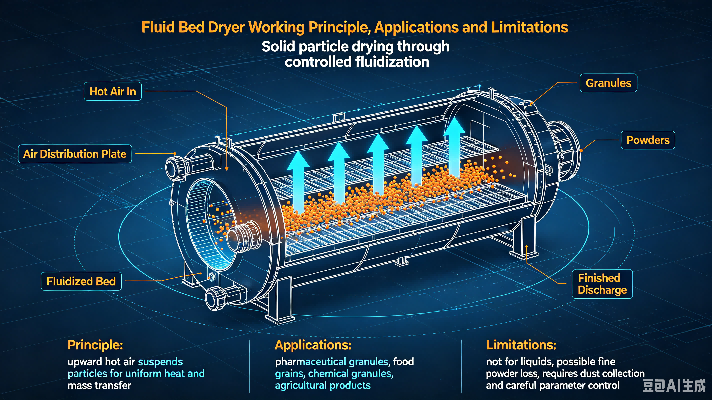
Fluid bed granulation, also known as one-step granulation, integrates three processes: powder mixing, spray granulation, and fluidized drying in one equipment. The hot airflow lifts and suspends powder materials to form a fluidized boiling state; the atomized adhesive liquid is sprayed evenly to bond floating particles into granules, and the hot air continuously dries the finished granules in real time.
Core advantages: One-step molding without intermediate material transfer, high production efficiency, uniform granule porosity, fast drug dissolution speed, and good batch consistency. The fully enclosed operation effectively avoids cross-contamination.
Applicable scenarios: High-standard GMP sterile production, traditional Chinese medicine granules, fast-dissolving solid preparations, high-uniformity granule production, and large-scale continuous pharmaceutical manufacturing.
3. Key Technical Parameters for Equipment Selection
When purchasing pharmaceutical granulation equipment, manufacturers must match parameters according to their own material characteristics and production scale. The core reference parameters are as follows:
3.1 Production Capacity & Batch Volume
Match the equipment model based on daily and annual production demand. Small experimental models (1–10L) are suitable for laboratory research, formula testing, and small trial production; medium models (50–200L) are applicable to medium-batch formal production; large industrial models (300L and above) meet large-scale continuous production needs. Over-sized equipment will cause energy waste and low equipment utilization, while undersized models will restrict production capacity expansion.
3.2 Material Adaptability
Different materials require targeted equipment configuration. For viscous and fine powders, choose high-shear wet granulators with strong shearing and mixing capacity; for heat-sensitive and hygroscopic materials, prioritize dry granulators or low-temperature fluid bed granulators; for high-purity sterile drugs, select fully enclosed, easy-to-clean fluid bed granulation equipment.
3.3 Granule Quality Precision
Key indicators include particle size range, particle size uniformity, granule hardness, and porosity. Qualified pharmaceutical granulation equipment should achieve adjustable particle size and stable batch difference, ensuring consistent tablet compression weight and drug dissolution performance. High-precision models support customized granule density for special preparation processes.
3.4 Material & Craft Standard
All equipment contact parts must adopt food-grade and pharmaceutical-grade stainless steel. 304 stainless steel is suitable for conventional drug production; 316L medical-grade stainless steel is mandatory for sterile preparations, injections, and high-corrosive raw materials, featuring better corrosion resistance, no rust, no material residue, and easy disinfection. The surface adopts mirror polishing or matte polishing treatment to avoid powder adhesion.
4. GMP Compliance & Certification Requirements
Pharmaceutical production equipment must strictly comply with GMP (Good Manufacturing Practice) standards, which is the core prerequisite for factory audit and market access. Key compliance requirements for purchasing are summarized as follows:
- Fully enclosed production design: Avoid external dust pollution and cross-contamination between materials; equipped with independent dust removal and exhaust systems.
- Easy cleaning and disinfection: No dead corners in the equipment structure, detachable parts, support CIP online cleaning and high-temperature disinfection, meeting sterile production standards.
- Stable parameter control: Intelligent temperature, humidity, rotating speed, and spraying volume closed-loop control system, with real-time data recording and traceability functions, meeting pharmaceutical production data integrity requirements.
- Qualified certification documents: The equipment must provide complete qualification certificates, material inspection reports, and GMP compliance verification documents to support factory inspection and drug registration.
5. Core Buying Factors & Common Pitfalls to Avoid
5.1 Key Buying Considerations
First, confirm the matching degree between equipment process and drug formula: select wet granulation for conventional stable materials, dry granulation for special sensitive materials, and fluid bed granulation for high-efficiency and high-standard production. Second, balance equipment performance and cost: prioritize stable quality and compliance for pharmaceutical equipment, and avoid blindly pursuing low prices. Third, inspect after-sales service system: confirm the supplier’s equipment installation, commissioning, technical training, and after-sales maintenance response capabilities to ensure long-term stable operation of the equipment.
5.2 Common Purchasing Pitfalls
- Blindly selecting high-power large-scale equipment, resulting in low load operation and increased production costs.
- Ignoring material adaptability, leading to poor granule molding, serious powder waste, and unqualified product quality.
- Purchasing non-standard equipment that does not meet GMP standards, causing failure in factory audits and production suspension losses.
- Focusing only on equipment price while ignoring after-sales service and spare parts supply, resulting in difficult equipment maintenance and long downtime.
6. Equipment Operation & Maintenance Cost Assessment
In addition to the one-time procurement cost, the long-term operating cost of granulation equipment should not be ignored. Wet granulation equipment requires supporting drying equipment, with high water and power consumption; dry granulation equipment has low energy consumption but higher requirements for roller wear resistance and regular replacement of wearing parts; fluid bed granulation equipment has high one-time investment but low labor cost and high production efficiency, suitable for long-term continuous mass production.
Regular daily maintenance including equipment cleaning, bearing lubrication, sensor calibration, and wearing parts replacement can effectively extend equipment service life, reduce failure rate, and lower long-term operating costs.
7. Conclusion
Pharmaceutical granulation equipment is the core equipment determining the quality of solid pharmaceutical preparations. The core of scientific purchasing is to match equipment type, parameters, and grade according to material characteristics, production scale, and GMP compliance requirements. Conventional mass production can choose cost-effective high-shear wet granulation equipment; special sensitive materials are suitable for dry granulation technology; high-standard sterile and high-efficiency production prioritizes fluid bed one-step granulation equipment. By avoiding purchasing pitfalls, focusing on compliance, performance, and after-sales guarantee, pharmaceutical enterprises can select the most suitable granulation equipment to stabilize product quality, improve production efficiency, and reduce comprehensive production costs.