Fluid Bed Dryer Working Principle, Applications and Limitations
1. Overview of Fluid Bed Dryer
A fluid bed dryer (FBD), also known as a fluidized bed dryer, is a high-efficiency industrial drying equipment widely used for moisture removal from powders, granules, crystals and pellet materials. Different from traditional static tray dryers, it adopts dynamic fluidization drying technology, which realizes uniform heat and mass transfer between materials and hot air. Featuring fast drying speed, consistent finished product quality and simple operation, it has become one of the mainstream drying equipment in pharmaceutical, food, chemical and agricultural processing industries. This article systematically elaborates on its working principle, core application scenarios and inherent limitations to provide professional reference for equipment selection and process optimization.
2. Working Principle of Fluid Bed Dryer
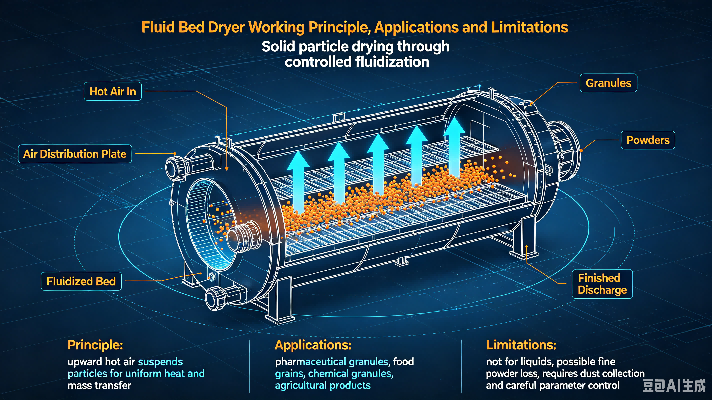
The core working logic of a fluid bed dryer is solid particle fluidization, which relies on upward high-speed hot airflow to convert static solid material piles into a turbulent fluid-like state, so as to achieve efficient and uniform drying. The entire working process can be divided into three core stages, with precise heat and mass transfer throughout the whole process.
2.1 Fluidization Formation
Clean and filtered air is heated to the set temperature by a heating system and then uniformly blown upward through a perforated distribution plate at the bottom of the drying chamber. When the upward airflow velocity exceeds the minimum fluidization velocity of the material particles, the gravity of solid particles is offset by air buoyancy and drag force. The particles are lifted, suspended and separated from each other, and the material bed presents a uniform boiling and flowing fluid state, which completely changes the static stacking state of traditional drying materials.
2.2 Efficient Heat and Mass Transfer
In the fluidized state, every single particle is fully and continuously contacted and washed by hot air without dead corners. The hot air rapidly transfers heat to the particle surface, making the surface moisture vaporize instantly. Driven by vapor pressure difference, the internal moisture of particles continuously diffuses to the surface and evaporates. The high-flow hot airflow quickly takes away water vapor, realizing synchronous and efficient heat transfer and mass transfer. This dynamic mixing mode eliminates the problems of uneven heating and slow internal drying of static materials.
2.3 Air Circulation and Material Discharging
After absorbing moisture and heat, the humid waste gas is discharged from the top of the drying chamber after dust removal and filtration to avoid material loss and environmental pollution. With continuous hot air circulation and fluidization movement, the material moisture is gradually reduced to the standard range. After the drying process is completed, the equipment stops air supply and heating, and the dried materials are automatically discharged, completing the whole drying cycle.
3. Main Industrial Applications
Fluid bed dryers are highly adaptable to granular and powdery materials with regular particle size, and are widely applied in multiple industrial fields with strict requirements for drying uniformity and efficiency.
3.1 Pharmaceutical Industry
It is the most commonly used drying equipment in pharmaceutical production, mainly for drying wet granules prepared by wet granulation, traditional Chinese medicine granules, pharmaceutical intermediate crystals and tablet raw materials. The uniform fluidized drying effectively avoids local overheating and material deterioration, meets GMP sterile production standards, and ensures stable drug efficacy and consistent batch quality.
3.2 Food and Agricultural Processing Industry
Widely used for drying food granules, seasoning particles, dehydrated vegetable grains, nut granules, grain seeds and agricultural by-products. The low-temperature uniform drying mode can well retain the original color, flavor and nutritional components of food materials, avoid material scorching and uneven drying, and improve the shelf life of finished food products.
3.3 Chemical Industry
Suitable for drying chemical granular materials, chemical crystals, mineral powders, plastic particles and catalyst particles. The equipment can adapt to the drying requirements of various conventional chemical materials, with fast drying speed and high production efficiency, and can effectively prevent material agglomeration during the drying process.
3.4 New Materials and Light Industry
It is applied to the drying of new material powders, battery raw material granules, ceramic powders and light industrial pellet products. The stable fluidization environment ensures no damage to fine material structures and uniform moisture content of finished products, meeting the high-precision drying requirements of new material industries.
4. Limitations of Fluid Bed Dryer
Although fluid bed dryers have prominent advantages in efficiency and uniformity, they have obvious application limitations restricted by structural principles and working modes, which are key factors that need to be considered in equipment selection.
4.1 Strict Requirements for Material Properties
The equipment is only applicable to powders and granular materials with uniform particle size, regular shape and good fluidity. It cannot handle viscous, paste-like, blocky and ultra-fine powdery materials. Viscous materials will adhere and agglomerate during fluidization and cannot be suspended evenly; ultra-fine powders are easily blown away by airflow, resulting in serious material loss and low yield. In addition, materials with too large particle size or too heavy weight cannot reach the fluidized state, leading to failed drying.
4.2 Unsuitable for Heat-Sensitive Special Materials
Although the drying temperature is controllable, the continuous high-speed airflow and particle friction will generate minor heat. For extremely heat-sensitive materials that are easy to decompose, oxidize and deteriorate at slight high temperatures, long-term fluidization drying will cause material activity loss and quality attenuation, so it is not suitable for ultra-high-precision heat-sensitive material processing.
4.3 High Energy Consumption for Airflow Operation
To maintain the stable fluidized state of materials, the equipment needs a high-power fan to provide continuous high-speed airflow, resulting in relatively high operating energy consumption compared with traditional tray dryers. For small-batch and low-value material drying, the operating cost is relatively high and the economic benefit is low.
4.4 Certain Material Fragmentation Risk
During the high-speed fluidization process, particles will collide and rub against each other and the equipment inner wall. For brittle, fragile and low-hardness granular materials, it is easy to cause particle fragmentation, affect the integrity and appearance of finished products, and reduce product grade.
4.5 Limitations in Large Bulk Material Drying
The fluidization uniformity is limited by the equipment cavity and airflow distribution. When drying materials with large bulk density differences or ultra-large batch volumes, local uneven fluidization is prone to occur, resulting in inconsistent moisture content of finished products and affecting batch production stability.
5. Conclusion
Fluid bed dryers occupy an irreplaceable position in the industrial drying field by virtue of high efficiency, uniform drying, stable quality and easy operation. They are the preferred equipment for standardized drying of granular and powdery materials in pharmacy, food and chemical industries. However, restricted by material adaptability, energy consumption and material fragmentation risks, enterprises need to fully combine material characteristics, production batch and product quality requirements for reasonable selection. Standard granular materials can give full play to the efficiency advantages of fluid bed dryers, while special materials need to be matched with other drying equipment to optimize the production process.